






-
Partager cette page
International Summer School in Anthropology and Ethnography 2026
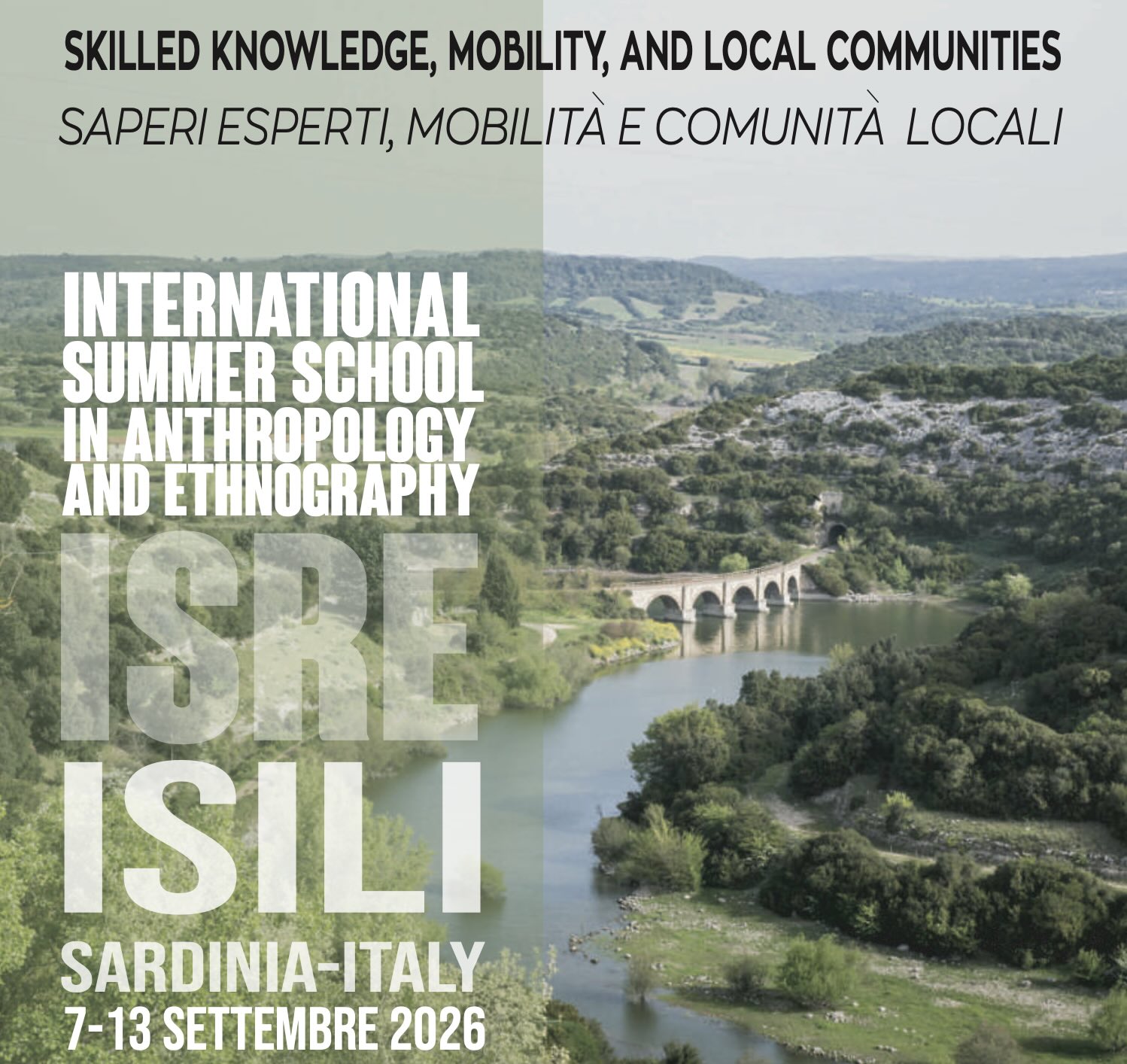
Skilled knowledge, mobility and local communities
Theme of the 2026 edition :
SAPERI ESPERTI, MOBILITA E COMUNITA LOCALI
Access the conference website
In its second edition, the ISSAE school meets Isili, a community in the Sarcidano area with a long tradition of craftsmanship in weaving and copperworking, which has historically linked these skills to the ability to create extensive exchange networks, spreading them along the island’s communication routes. The Isili community has demonstrated its ability to represent itself through two important ethnographic museums: the Museum of Traditional Weaving and the MARATE (Museum of Copper and Textile Art).
The training activities planned in Isili will take into account the complex cultural and social reality of the community, which is characterized by important aspects of entrepreneurial and cultural dynamism linked to the presence of a significant economic and productive fabric compared to other areas of the island, and important previous work on the material and symbolic heritage of craftsmanship, as well as on local memory, as evidenced by the museums and the cultural and educational tradition of the town (public library, reading centers, schools, cultural associations).
Isili and the entire Sarcidano area, however, are, like the whole island, subject to a decline in population and rural abandonment, which remains the underlying factor in every survey and every educational project on the locality in Southern Europe.
General Program
Download the program
The second edition of ISSAE will last seven days, from September 7 to 13, and will take place in Isili.
The first three days will begin with morning sessions dedicated to seminars, oral presentations, and debates, while the afternoon and evening will feature workshop activities and field exercises. The fourth day will be dedicated to a territorial visit(Samugheo, Mogoro, Siddi).
On the last two days, participants will focus exclusively on field research. At the end of the Summer School, there will be a public round table discussion of the work (reports, photographs, videos, video interviews, etc.) produced by the participants.
Target
Master’s students, postgraduate students, and doctoral students with degrees in demo-ethnoanthropology and other fields of the humanities, as well as personnel involved in cultural activities such as the protection, preservation, and enhancement of cultural heritage, are eligible to enrol in the ISSAE.
Participants are required to bring audio-visual equipment (smartphone/camera/video camera) for field research.
Scientific Committee and Coordinator
The Scientific Coordinator of the second edition of ISSAE is Prof. Felice Tiragallo.
National and international institutional partners
- CRIA – Centro em Rede de Investigação em Antropologia, Lisboa / IN2PAST – Laboratório Associado para a Investigação e Inovação em Património, Artes, Sustentabilidade e Território. Academic contact: Prof. Antonio Maria Pusceddu.
- EHESS – École des Hautes Études en Sciences Sociales, CeRCLEs – Centre de recherche sur les circulations, les liens et les échanges, Marseille. Academic contact: Prof. Valeria Siniscalchi.
- KSA – Institut für Kultur- und Sozialanthropologie, Universität Wien. Academic contact: Dr. Greca N. Meloni.
- LISST – Laboratoire Interdisciplinaire Solidarités, Sociétés, Territoires, CNRS and Université de Toulouse Jean Jaurès. Academic contact: Prof. Flavia Carraro.
- Department of Humanities and Social Sciences, University of Sassari.
- Department of Literature, Languages, and Cultural Heritage, University of Cagliari.
- International Doctorate in History, Cultural Heritage, and International Studies, University of Cagliari.
- LEV – Laboratory of Visual Ethnography, Department of Literature, Languages, and Cultural Heritage, University of Cagliari.
- School of Specialisation in Demo-Ethno-Anthropological Heritage, Department of Philosophy, Social Sciences, Humanities, and Education, University of Perugia.
- University of Cagliari
Organizing Committee
Prof. Tatiana Cossu and the tutors Dr. Nicolò Atzori, Dr. Benedetta Onnis, Dr. Riccardo Uras and Dr. Jessica Zappalà.
Contact : Flavia CARRARO